
 Green Water Technology Co.,Ltd
Home
Library
Article
Jet Submersible Aerator
Jet Aerator
Why Use Jet Aerator?
Currently, the most common method of aeration is the blower system. However, after prolonged operation, issues such as aging, cracking, and clogging of the aeration heads, as well as wear and tear on the blowers, often arise. To account for these factors, blower capacity is typically oversized during the design phase. Additionally, traditional aeration equipment requires annual maintenance, which involves shutting down the system and draining the water—a process that is both complex and costly. Furthermore, as the volume of treated water increases and load fluctuations occur, this often leads to problems such as insufficient oxygen supply.
Principle of Jet Aerator
To address this issue, Chengdu Greenwater Technology Co., Ltd. has developed a jet aerator, which is primarily used in the biological aeration process for treating municipal sewage and industrial wastewater.
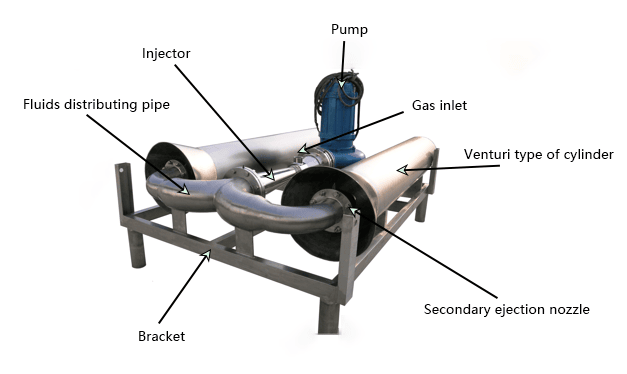
The jet aerator mainly consists of water pump, Venturi Injector, energy-enhancing nozzle, secondary jet guide tube (optional).
After the mixed liquid (sewage + sludge) is drawn in by the water pump, it undergoes jet mixing with air/ oxygen within the Venturi jet mixer to form a supersaturated oxygen-water mixture. This mixture is then jetted through a set of energy-enhancing nozzles into the tank or secondary jet guide tube. The secondary jet generated by the energy-enhancing nozzles recovers the pump’s energy, creating a flow effect in the tank or guide tube equivalent to five times the pump’s flow rate, thereby facilitating the process of hydraulic circulation and oxygenation within the tank.
This characteristic enhances the efficiency of oxygen transfer in water, thereby significantly improving oxygen utilization and the kinetic efficiency of oxygen transfer, and ensuring the required dissolved oxygen concentration in the mixed liquor for the efficient treatment of industrial and domestic wastewater.
Jet Aerator Pic:
Advantages of Jet Aerator:
1. High oxygen utilization and high power efficiency, with no decline over time.
2. Maintenance can be performed without interrupting water flow, making repairs convenient and cost-effective.
3. Low noise levels; the Q-type installation configuration achieves near-silent operation.
4. Existing blower/compressor systems can be utilized for pressurized jet aeration, significantly improving oxygen utilization.
5. Combining blower systems with jet aeration can significantly reduce operational energy consumption.
6. Enhanced resistance to shock loads.
7. Eliminates the complex piping of traditional blower systems; maintenance is convenient and cost-effective without the need to shut down water supply
Applications of Jet Aerator:
Jet aerator are suitable for various wastewater treatment applications, including push-flow aeration tanks, mixed-flow aeration tanks, extended-retention-time aeration tanks, oxidation channels, and oxidation ponds.
Selection of Jet Aerator:
Installation Instructions for Jet Aerators:
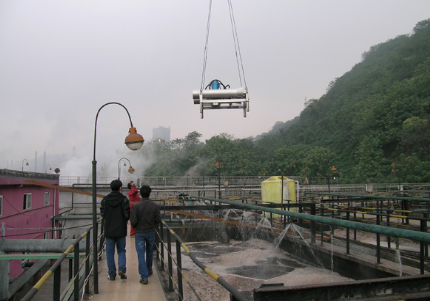
Installation of Jet Aerator in Water
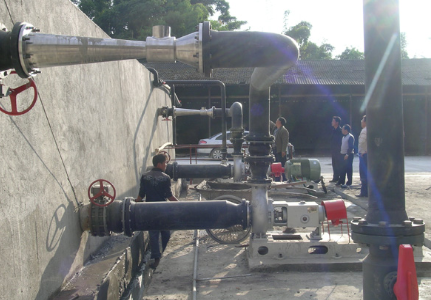
Dry Installation of Jet Aerator
Case Study: Jet Aerator:
Please refer to the case study:
1. Application of Jet Aeration in Sugarcane Wastewater Treatment
2. Application of Jet Aeration in Landfill Leachate Treatment